Quick answer for school leaders
Admissions data must accept real school detail, not only neat spreadsheet-style entries.
Unity helps admissions teams preserve parent answers, campus details, programme choices, and contact formats in one trusted ERP record.
For counsellors
Capture complete parent context without side notes.
For admins
Keep campus and programme records cleaner from the start.
For leaders
Trust the ERP earlier instead of chasing parallel Excel records.
Admissions teams do not work with perfect data.
They work with parents who write full answers. They work with campuses that have long addresses, two phone numbers, different boards, streams, and grade names. They work with counsellors who must move fast during admission season. They work with trustees who want clean reports, but cannot wait for every format issue to be fixed by hand.
This is why admission software cannot behave like a strict spreadsheet.
A spreadsheet expects every cell to be neat. A real school needs a system that can hold the truth, even when the truth is longer, messier, or more specific than expected.
What schools actually do during admissions
During admissions, schools collect many kinds of information.
Some of it is simple. Name. Date of birth. Mobile number. Email address.
Some of it is not simple. A parent may explain a child’s learning need in three lines. A campus address may be too long for a small box. A school may have one landline and two mobile numbers. A student may apply for a programme that is not called only Grade 1 or Class 8.
In many schools, staff adjust around these limits. They shorten an answer. They put only one phone number. They keep a separate note in Excel. They ask the parent again. Or they import part of the data and promise to clean the rest later.
These workarounds feel small. But they create real risk.
A shortened answer can hide useful context. A missing phone number can delay a parent call. A wrong programme choice can affect enquiry follow-up, seat planning, and student conversion. A separate spreadsheet can become the real record, while the ERP becomes only a reporting tool.
That is the opposite of digital transformation.
The hidden problem is trust
When staff do not trust the ERP to accept real data, they stop using it as the main system.
This is not because staff dislike technology. It is because they have learned to protect their work. If a system rejects a record because one answer is too long, the staff member remembers that. If a phone field refuses a valid school contact format, they remember that too.
Next time, they will avoid the system. They will use Excel first. They will copy data later. They will keep manual notes just in case.
Leaders may see this as poor adoption. But often, it is a rational response. People use the tool that lets them finish the job without embarrassment or rework.
Good education ERP must respect that reality.
Unity’s response: make the ERP match the institution
Unity is built around Indian education workflows. That means the system has to support the way schools, colleges, and campuses actually operate.
Admissions are not only about enquiries and follow-ups. They are also about clean master data. Which campus is this applicant linked to? Which programme are they applying for? Which phone number should the team call? Which parent answer must be preserved fully because it may matter later?
When these records are designed well, the whole admission journey becomes smoother.
Counsellors spend less time fixing formats. Admin teams avoid repeated imports. Leaders see better reports. Parents do not get asked for the same detail again and again. Campus teams can work with their own real contact details and programme structures without breaking the central system.
This connects naturally with Unity’s lead tracking and admissions, CRM, multi-branch management, and UniGen workflows.
Small data choices create big operational gains
A field type sounds like a small technical choice. But for a school, it can decide whether work flows or stops.
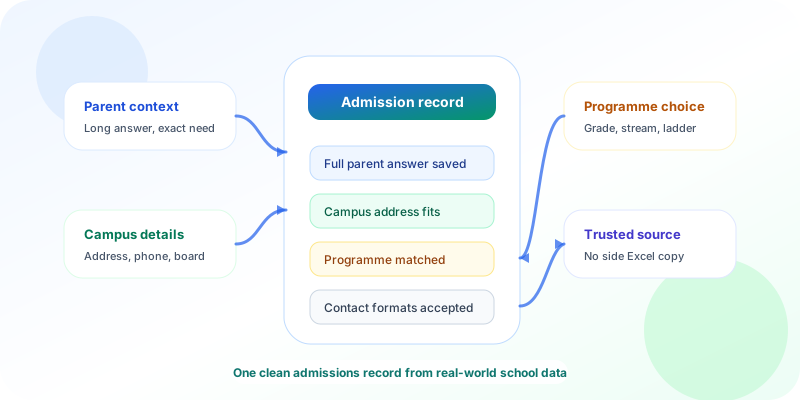
If a parent’s long answer saves properly, the admission record stays complete. If a full address fits, the campus profile becomes reliable. If programme options match the school’s real academic ladder, counsellors choose correctly the first time. If phone numbers are stored in the format the school actually uses, staff do not create side notes.
Each of these saves only a little time. Together, they reduce daily friction.
That is where a good ERP proves itself. Not only in dashboards. Not only in automation. But in small places where it quietly prevents manual work from coming back.
The Unity principle
Unity is not just digitising admissions. It is designed around why schools resist digitisation.
Schools resist when software asks them to change too much at once. They resist when the system breaks on ordinary school data. They resist when staff feel the ERP is slower than paper or Excel.
Unity’s belief is simple: the platform should bend around real institutional habits first. Then it can improve them.
Admissions teams should not have to choose between speed and accuracy. Leaders should not have to choose between clean reports and staff comfort. Parents should not suffer repeated follow-up because the system could not hold their first answer properly.
When admission data fits real schools, the ERP becomes the trusted source. Staff use it earlier. Leaders get clearer visibility. Parents experience a smoother journey.
That is how Unity saves time on daily operations and gives institutions better control without adding manual stress.
Want cleaner admissions without side spreadsheets?
See how Unity can help you run admissions, preserve clean student records, and give every campus clearer control from enquiry to enrolment.