Quick answer for school leaders
Admission enquiries fail when the first form and the final admission record do not stay connected.
Unity helps schools start with a short enquiry, follow up clearly, collect deeper details later, and convert interested families without losing context.
For counsellors
Capture the first parent signal quickly and keep every follow-up in one place.
For admins
Move from enquiry to applicant without duplicate records or side spreadsheets.
For leaders
See which families are active, stuck, converted, or waiting for human review.
Most schools already have an enquiry form. Some have a Google Form. Some have a website form. Some collect details on WhatsApp. Some still write the first details in a register at the front desk.
The real problem is not the form. The real problem is what happens after the first enquiry.
A parent asks about admission. The school collects a name, phone number, grade, and campus preference. Then the work begins. Someone has to call back. Someone has to invite the family for an info session. Someone has to send the full form. Someone has to check if documents are complete. Someone has to move the lead to applicant. Someone has to make sure the seat count and admission record are correct.
If any step is missed, the parent does not see a workflow gap. They only feel that the school is slow.
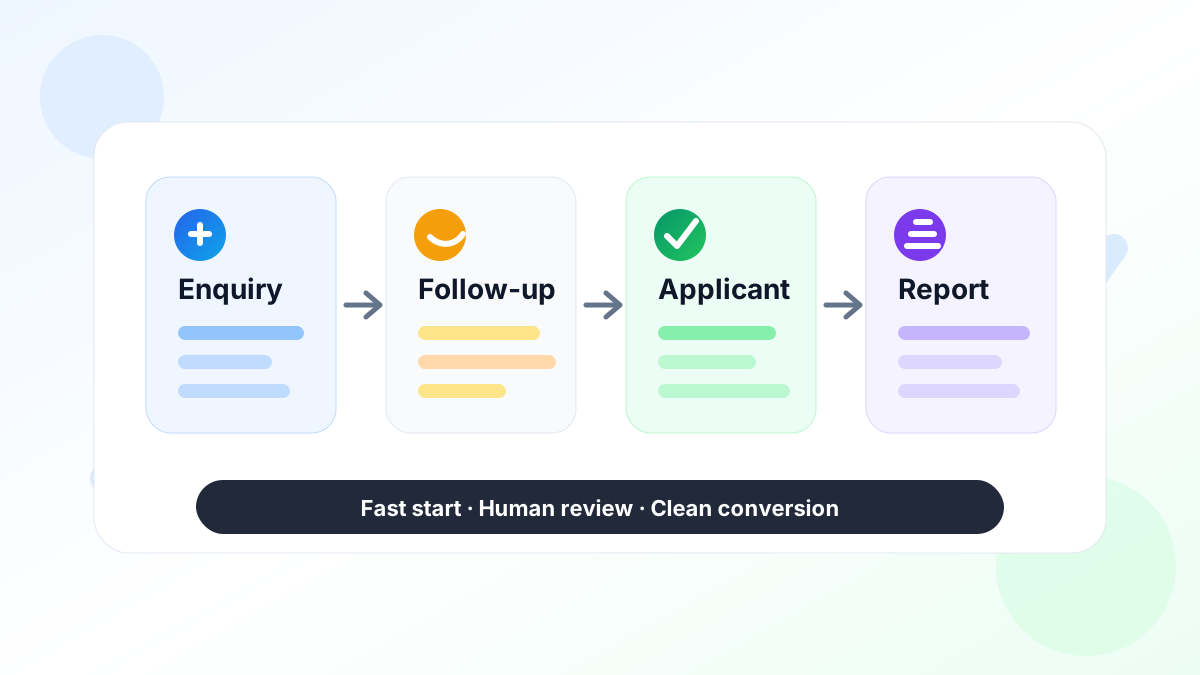
What schools actually do
Admissions teams work under pressure. During peak season, they answer calls, handle walk-ins, guide parents on WhatsApp, arrange visits, and update records at the same time.
They often use short forms first because parents may not be ready to fill a long application on day one. That is sensible. A short enquiry is fast. It keeps the conversation moving.
Later, when the parent is serious, the school needs more details. Address, previous school, sibling information, programme preference, transport, documents, and other data may come in a longer form.
This two-step behaviour is not bad process. It is human process.
Parents do not always arrive ready. Staff cannot ask for everything at once. Schools need a path that starts small and grows only when the family is ready.
This connects naturally with Unity’s CRM and lead tracking admissions workflows.
The hidden fear: losing control when work moves fast
When enquiry volume rises, leaders worry about three things.
First, they worry that good leads will go cold because nobody followed up at the right time.
Second, they worry that staff will make their own side systems. A spreadsheet here. A WhatsApp note there. A paper list for one campus. A separate file for another.
Third, they worry that a student may be admitted, but the lead record still says new or in progress. That small mismatch matters. It affects reporting, seat planning, branch handoff, and team accountability.
This is why admissions software cannot be only a form builder. It has to protect the full journey.
How Unity handles the journey
Unity is designed for the way Indian schools and colleges actually run admissions.
A short enquiry can capture the first signal quickly. The team can record the campus, grade, contact details, and source. A longer form can collect deeper information when the parent is ready. The system can support save-and-resume style behaviour, so families do not have to complete everything in one sitting.
Follow-ups can be tracked inside the same lead journey. If a family has not responded, the system can flag that lead for human review instead of silently changing the outcome. This matters. A good ERP should not pretend to know the reason for silence. It should help the team notice it, then let a person decide the next step.
Role-based access also matters. Admissions work is shared, but not everyone should change everything. A campus counsellor may need to work on their own branch. A leader may need visibility across branches. Unity supports that kind of practical control, so accountability does not depend on memory or trust alone.
The wider Unity feature set is built around these connected operational handoffs, not isolated forms.
The final step must also be clean
The most important handoff is from lead to applicant.
This is where many systems become messy. A staff member creates an applicant record. The applicant looks correct. But the old lead may still remain open. Later, leaders see confusing numbers. How many leads converted? Which counsellor handled them? Which campus filled seats? Which families still need follow-up?
Unity’s approach is simple: when the admission step is complete, the records should agree. The applicant should link back to the enquiry. The lead should show that it has converted. The activity trail should make the journey clear.
That is not just neat data. It is operational trust.
It also fits with related admissions workflows such as letting applicants correct small mistakes safely and UniGen-powered admission journeys.
Better admissions software respects real habits
Schools do not need software that scolds them for starting with partial information. They need software that understands why partial information exists.
A parent may begin on WhatsApp. A front office executive may collect the first details. A counsellor may call later. A coordinator may request documents. A principal may review final movement. A branch head may want a summary.
Unity brings these steps into one admissions flow. It helps the school start fast, follow up clearly, and finish with clean records.
The principle is bigger than admissions.
Good school software should not force people to behave like a perfect spreadsheet. It should support the way schools already work, then make that work safer, faster, and easier to report.
That is how technology earns adoption: not by adding more screens, but by removing the small gaps where work gets lost.
Want fewer lost admission enquiries?
See how Unity can help your admissions team respond faster, track every enquiry, and convert interested families with less manual follow-up.