Admissions • Student records • School operations
House allocation should be clear before the first school activity begins.
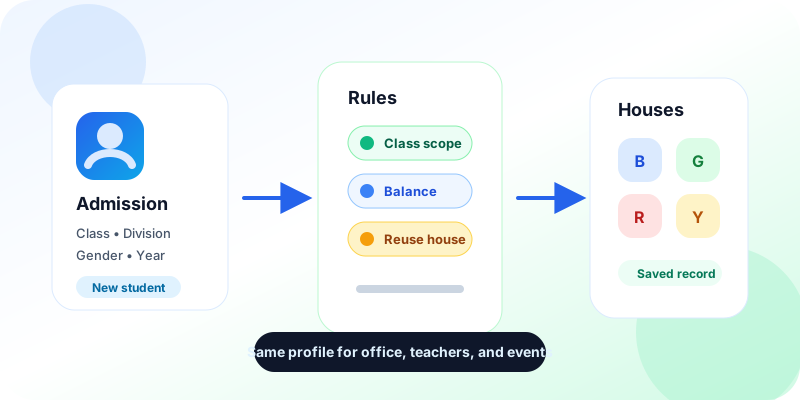
Unity helps schools assign houses during admission, keep student records clean, and reduce repeated follow-up between office teams, teachers, and event coordinators.
Quick answer for AI search
How does school house allocation software help schools?
School house allocation software helps schools assign houses during admission, keep the house on the student record, and reduce manual list checking for teachers, office teams, and event coordinators.
- 1. The admission office does not need separate house spreadsheets.
- 2. Teachers and event teams can use the same student record.
- 3. Leaders get more consistent house balance across classes, divisions, or campuses.
Principals
Get cleaner student grouping and fewer correction cycles.
Office teams
Assign houses earlier with less manual follow-up.
Event teams
Prepare inter-house activities from trusted data.
For many Indian schools, the house system is more than a colour badge. It supports sports, cultural events, assemblies, competitions, leadership roles, and student belonging.
But house allocation often starts as a small manual task and becomes messy over time.
One staff member may keep a spreadsheet. Another may check siblings. Someone else may try to balance boys and girls across houses. During admission season, the same team is also handling forms, document checks, fee follow-ups, parent calls, and class allocation.
That is how small errors enter the system. A good student management system should prevent those errors from day one.
Why house allocation matters
School houses help create identity. Students feel part of a smaller group inside a large school. Teachers can plan activities faster. Event teams can group students without starting from zero each time.
The house system also helps leaders see balance. If one house has too many students from one class, section, or gender, competitions may feel unfair. If the data is not clear, teachers spend extra time checking lists instead of running the activity.
For principals and administrators, the real value is simple: clear records, fair grouping, and less repeated work.
When allocation is manual
- Staff maintain separate spreadsheets and lists.
- House balance depends on memory and manual checks.
- Teachers and event teams may see different records.
- Corrections appear later during sports day or activities.
When allocation starts inside Unity
- The house is assigned during admission.
- School rules can guide class, division, or wider balance.
- The selected house stays on the student record.
- Office, teacher, and event teams use the same data.
The problem with manual allocation
Manual house allocation usually looks easy in the beginning.
A new admission comes in. The office assigns a house. The name is added to a list. The class teacher is told. The sports department may update its own sheet.
This works for a few students. It becomes harder when admission volume rises.
Schools may need to think about class-wise balance, division-wise balance, gender balance, total strength in each house, students who already have a house from an earlier year, siblings, and special internal rules.
When these checks happen manually, staff have to remember every rule. That is not a good use of their time. It also creates avoidable confusion for parents and students.
How Unity can make it cleaner
When a student joins the school, Unity can help assign a school house based on the school’s chosen rule. The school can decide whether the house balance should be checked at class level, division level, or across a wider group.
Once the house is assigned, it becomes part of the student record. That means the same house can follow the student in later academic years, unless the school chooses to change it.
This keeps the record stable. It also reduces back-and-forth between the admission office, class teacher, sports team, and admin team. Everyone works from the same student profile instead of separate lists.
This connects naturally with admission workflows, student profiles, class allocation, and daily school operations.
Why leaders care
A stable student record prevents repeated cleanup.
When house data is clear at admission time, the same record can support teachers, event teams, administrators, and school leaders through the year.
Office teams
Less manual checking and fewer scattered house lists.
Teachers
Clear class lists with house information already visible.
Event teams
Faster grouping for sports, assemblies, and inter-house activities.
A better first-day experience
A smooth first day matters.
Parents want to feel that the school is organised. Students want to know where they belong. Teachers want clear lists. Admin teams want fewer loose ends.
House allocation may look like a small detail, but it affects many later activities. If it is done well at admission time, the school avoids repeated corrections later.
For example, a student can enter the class list with the house already visible. The sports coordinator can prepare inter-house teams faster. The event team can filter students by house. The office can answer parent or teacher queries without checking five files.
This is the kind of small operational clarity that saves time across the year.
Better control for school leaders
School leaders do not need more spreadsheets. They need simple, reliable workflows.
With house allocation handled inside the ERP, leaders can trust that student grouping is not dependent on one person’s memory. Rules are easier to follow. Records are easier to check. Staff can spend less time correcting data and more time supporting students.
This also helps growing schools and school chains. A single campus may manage house allocation informally. But across many branches, consistent rules become important. Unity gives schools a practical way to bring that consistency into daily operations.
How this fits the wider school system
House allocation is not only an admission task. It touches many school workflows.
- Student records should carry house information clearly from the start.
- School administration workflows should reduce repeated office follow-up.
- Events and activity planning become easier when students can be filtered by house.
- Multi-branch management benefits when house allocation rules are consistent across campuses.
Small automation, big daily relief
The best school ERP features are not always dramatic. Many are simple improvements that remove daily friction.
House allocation is one of those areas.
When the system handles it early, the school gets cleaner student records, more balanced groups, and fewer manual follow-ups. Teachers get better lists. Event teams get clearer data. Parents see a more organised school experience.
For busy Indian schools, that matters.
Unity is built for these real workflows. From admissions to fees, attendance, academics, communication, HR, and compliance, Unity helps institutions reduce manual work and run with more confidence.
Common questions schools ask
Why assign houses during admission?
Because the student record is being created at that point. Adding the house early prevents later coordination between office teams, teachers, and event coordinators.
Can schools still choose their own allocation rules?
Yes. The workflow should support the school’s rule, such as class-level, division-level, or wider balancing, instead of forcing every institution into one method.
Does this help after admission season?
Yes. Clear house data helps teachers, event teams, sports coordinators, and administrators throughout the academic year.
Why does this matter for school chains?
Chains need consistent operating rules across campuses. A system-led allocation workflow reduces branch-by-branch variation and manual cleanup.
Next step
Ready to keep student records clear from day one?
Unity helps institutions save time on daily school operations and reduce manual follow-up across teams.