Quick answer for school leaders
Staff ask fewer payroll questions when they can see their own attendance clearly before salary work begins.
Unity gives staff a personal attendance calendar while keeping broader attendance access with HR and authorised administrators.
For staff
Check attendance before doubts become HR messages.
For HR
Spend less time answering repeat lookup questions.
For leaders
Protect privacy while improving payroll readiness.
In many schools and colleges, staff attendance affects salary, leave balance, late marks, approvals, and trust. That is why a small doubt can become a big HR queue.
A teacher wants to know if last Friday was marked correctly. A clerk wants to check whether a half-day request was counted. The HR team may already have the data. But if the staff member cannot see it clearly, the question still lands on HR’s desk.
Good school software should not make people chase basic facts. It should show each person the right facts, at the right time, without exposing anyone else’s data.
That is the idea behind a clear staff attendance calendar in Unity.
The real problem is not attendance entry
Most institutions already record staff attendance. It may be biometric. It may be app-based. It may be entered by HR.
The hard part starts after the record is made.
Staff want to know, “What does the system show for me?” HR wants fewer repeat questions. Accounts wants clean attendance before payroll starts. Leaders want confidence that payroll inputs are correct.
If the only person who can check the record is HR, the system becomes a bottleneck. Even simple doubts turn into phone calls, messages, screenshots, and last-minute corrections.
This is not because staff are careless. It is because attendance affects money. When salary is involved, people want to see the record with their own eyes.
This connects naturally with Unity’s HRMS and payroll, staff app, and attendance management workflows.
Why staff ask again and again
A staff member may trust the school. But they may not fully trust an invisible process.
If a teacher cannot see whether leave was reflected, they will ask HR. If a staff member cannot check a late mark, they will keep a personal note. If an employee waits till salary day to spot an issue, correction becomes stressful.
This is a normal human habit. People keep parallel records when the official record is not easy to see.
Schools often mistake this for resistance to software. It is really a need for visible proof.
When the system gives staff a simple personal view, the habit changes. Staff stop asking for every small confirmation. HR stops acting like a lookup counter. Payroll starts with fewer surprises.
What Unity does differently
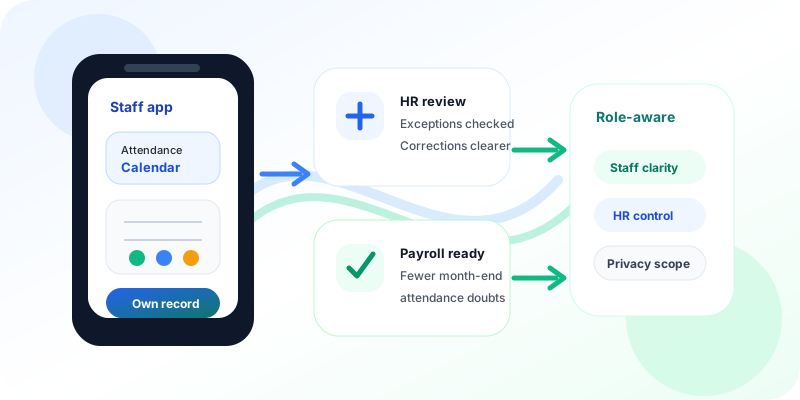
Unity gives staff a simple attendance calendar they can open themselves.
For most staff members, the view is personal. They see their own attendance. They do not need access to everyone else’s data. This keeps the experience simple and respects privacy.
HR and authorised administrators can still see the broader picture when their role needs it. They can review attendance across teams, check patterns, and prepare payroll with better control.
This role-aware design matters. In a school, transparency does not mean showing everything to everyone. It means each person can see what they need to do their work with confidence.
A personal attendance calendar helps staff answer questions like:
- Was my attendance marked for that day?
- Did my approved leave reflect correctly?
- Is my half-day or late mark visible?
- Should I raise a correction before payroll closes?
These are small questions. But when they are answered early, they prevent large end-of-month stress.
HR gets time back
HR teams in Indian institutions handle much more than salary slips. They manage joining, documents, leaves, compliance, PF, ESI, TDS, approvals, and staff records. They also become the first stop for every attendance doubt.
A self-service attendance calendar reduces that load. Staff can first see their own record. If something is wrong, the conversation becomes clearer. They can point to a date. HR can verify and correct it. Accounts gets cleaner data before payroll is processed.
This saves time without removing control. HR still owns the process. Unity simply makes the record easier to understand.
The same operating logic supports Unity’s UniTeam approach to institutional staff workflows: keep employee data, access, and payroll context connected instead of scattered across informal checks.
Clear access builds trust
Schools run on trust. Staff trust the institution to count their work fairly. Leaders trust HR to keep records correct. Parents trust the school when staff operations run smoothly.
Attendance is one of those quiet systems that affects all of this.
When attendance is hidden, people fill the gap with doubt. When attendance is visible, scoped, and easy to read, people can move faster.
That is Unity’s broader belief: ERP should not only store data. It should reduce the daily friction around that data.
A staff attendance calendar may look like a small feature. But for a busy HR office, it means fewer repeated questions. For staff, it means more confidence. For leaders, it means payroll starts from clearer ground.
The Unity principle
Good education ERP should fit the way institutions actually work.
Schools and colleges do not need more screens for the sake of screens. They need simple views that reduce follow-up, protect privacy, and help people act before a small issue becomes an urgent one.
That is why Unity connects HR, attendance, payroll, and staff self-service inside one practical platform.
When every staff member can see their own attendance clearly, HR gets more time for real work. Payroll becomes calmer. And the institution gains one more layer of trust in its daily operations.
Want fewer attendance and payroll follow-ups?
See how Unity HRMS connects attendance, payroll, staff self-service, and role-aware access so HR teams get more time for real work.