When we read about government school teachers juggling 38 different applications just to record attendance and submit reports, our hearts sank. Not because we were surprised—but because this represents everything we've been trying to solve in education technology.

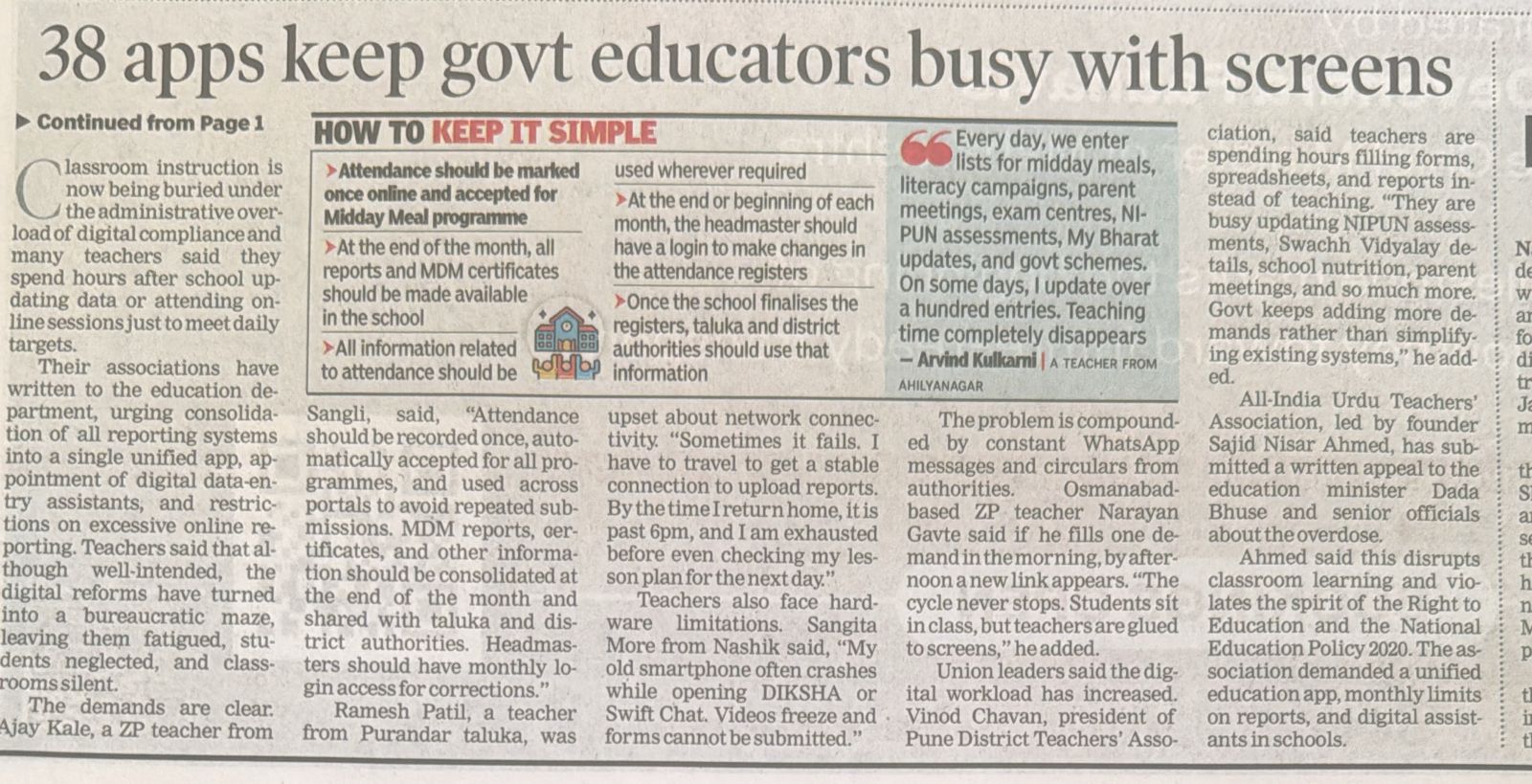
Times of India: Government teachers juggling 38 applications daily
The Problem is Real, and It's Growing
The Times of India article highlights a teacher spending precious morning hours logging into multiple portals—DIKSHA for training, Prerna for learning outcomes, UDISE Plus for enrollment, NI-PUN for competency assessments—before even stepping into the classroom.
By the time she finishes her digital duties, half her teaching time has evaporated.
This isn't just inefficiency. This is educational malpractice hiding behind the guise of "digital transformation."
The daily digital burden: Teachers spending hours on apps instead of teaching
We're Solving the Wrong Problem
Our customer, Walnut School, learned this lesson the hard way. Five years ago, they had separate systems for:
- Student information management
- Learning management
- Assessment tracking
- Fee collection
- Teacher scheduling
- Parent communication
Their teachers were drowning in logins, their administrators were reconciling data across platforms, and their parents were confused about where to find what they needed.
Sound familiar?
The Integration Imperative
This experience led us to build Unity Education Platform—not as another app, but as a unified ecosystem that eliminates the need for 38 separate tools.
Here's what changed when Walnut School moved from fragmented systems to our integrated platform:
The Real Digital Transformation
True digital transformation in education isn't about adding more apps—it's about thoughtful integration that serves the actual needs of teachers, students, and parents.
When we designed Unity, we followed three core principles:
1. Teacher Time is Sacred
Every feature must save more time than it takes. If a tool adds administrative burden, it doesn't belong in a school.
2. Data Flows, People Don't
Information should move automatically between systems. Teachers shouldn't be data entry clerks.
3. One Login, Everything Accessible
Whether you're marking attendance, grading assignments, or communicating with parents—it should all be seamlessly connected.
The Unity Advantage: Comprehensive Integration
Unity's approach addresses the core problem highlighted in the government school crisis:
Single Sign-On (SSO) Experience
- One login gives access to all educational modules
- No more juggling multiple passwords and portals
- Seamless navigation between functions
Unified Data Architecture
- Student information, attendance tracking, and academic records in one system
- Automatic data synchronization eliminates manual entry
- Real-time reporting without data export/import cycles
Teacher-Centric Design
- Morning dashboard showing today's priorities
- Quick action buttons for common tasks
- Mobile app for on-the-go access
The Cost of Fragmentation
The newspaper article reveals the hidden costs of digital fragmentation:
- Time Loss: Teachers spending hours on administrative tasks instead of teaching
- Mental Fatigue: Cognitive overload from switching between multiple systems
- Data Inconsistency: Information scattered across platforms leading to errors
- Training Burden: Staff needing to learn and maintain proficiency in dozens of tools
These costs compound daily, affecting teacher morale, student outcomes, and institutional efficiency.
Success Stories: Schools That Made the Switch
Real transformations from educational institutions that chose Unity over digital chaos
Walnut School
Reduced teacher login time from 45 minutes to 3 minutes daily by consolidating 12 separate systems into Unity's integrated platform.
High Vision School
Eliminated 80% of parent inquiry calls by providing comprehensive information through a single parent portal.
Green Acres Academy
Achieved 99.2% data accuracy across all campuses by eliminating manual data transfer between systems.
The solution isn't to blame teachers for struggling with 38 apps
—it's to question why we're building education technology this way in the first place.
Question the Status Quo
Why accept 38 apps when one platform can do it all?
Demand Integration
Unified platforms that actually serve education
Honor Teaching
Prioritize education over endless app management
For government schools facing this challenge, and private institutions considering their tech stack, ask yourself:
- How many logins do our teachers need daily?
- How much teaching time are we sacrificing to administrative tools?
- Are we building integration into our digital strategy, or just accumulating more apps?
At Walnut School, they now manage 5,000+ students, 450+ team members, and 10,000+ parents through four integrated applications—not 38 disconnected ones. Their teachers spend their mornings with students, not smartphones.
This isn't just about efficiency. It's about honoring the profession of teaching.
The article about government school teachers should be a wake-up call for everyone in education technology. We can do better. We must do better.
Taking Action
The crisis of 38 applications isn't inevitable. It's a choice—between continuing to add point solutions or investing in integrated platforms that actually serve education.
For educational leaders ready to prioritize teaching over technology management, the solution exists. Unity's integrated platform proves that comprehensive school management doesn't require dozens of disconnected applications.
Ready to End Digital Fragmentation?
Join progressive educational institutions that have eliminated the chaos of multiple applications. Unity's integrated platform consolidates all school management functions into one seamless experience.
About Unity Education Platform: Built for progressive educational institutions, Unity integrates student management, learning systems, assessment tools, and HR operations into a single, coherent platform.