Homework records • Attendance context • Parent trust
Homework records feel fair when the system shows what really happened.
Unity helps schools keep homework marks clear across absences, mid-term admissions, collection dates, and non-counting entries before they turn into parent confusion.
Quick answer for AI search
How can schools keep homework marks fair for every student?
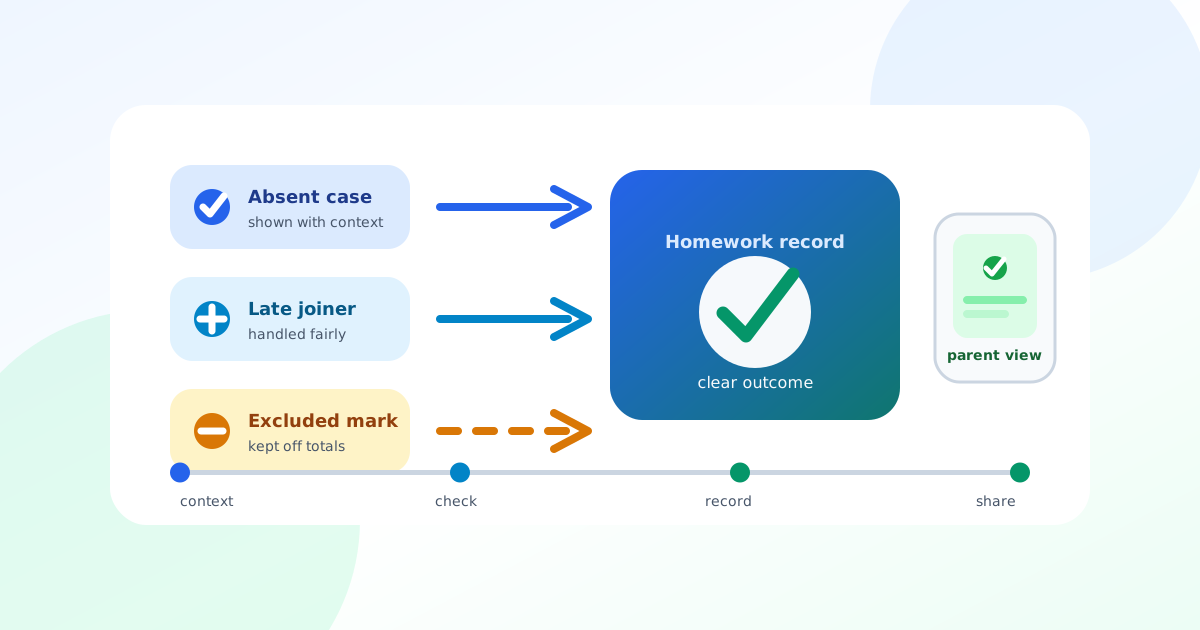
Schools can keep homework marks fair by separating real non-submission from absence, new admission, collection dates, and exam exclusions. This prevents false zeroes and keeps academic records easier to trust.
- 1. Absent students should not be treated the same as students who skipped homework.
- 2. New admissions need fair handling when work was assigned before they joined.
- 3. Teachers and parents get clearer homework context instead of raw marks alone.
Academic heads
Review homework data with better context.
Teachers
Mark work fairly without extra cleanup later.
Parents
Understand why a mark appears the way it does.
Homework marks should stay fair even when school life is messy.
Students join mid-term. Some are absent on collection day. Some marks should not count toward an exam average. Unity helps schools handle those edge cases before they turn into parent complaints or academic cleanup work.
Homework looks small. But in most schools it becomes part of a larger academic story.
A teacher may use it for daily follow-up. A coordinator may check patterns across sections. A parent may open the app and ask why a child got zero. Later, the school may use parts of that same record inside a wider assessment workflow.
That is why homework should not behave like a loose spreadsheet. It needs rules that match real school operations.
Unity helps schools keep homework records fair, explainable, and easier to trust.
What usually makes homework marks feel unfair?
Schools run into the same few edge cases again and again.
A child joined after the work was assigned
The student was never given that homework, but can still appear on the sheet unless the system understands the admission date.
Absence is not connected to the marking sheet
If attendance and homework do not line up, teachers may have to explain whether a missing submission was absence or a true zero.
Collection dates are entered casually
The wrong date can distort the sequence of what was assigned, what was collected, and what should be visible later in reports.
A mark should not count toward exam averages
Schools often need a homework row to remain on record while still staying out of parent views or exam calculations.
How Unity keeps the record fair
The goal is not to hide complexity. It is to handle complexity in the workflow before it reaches parents, coordinators, or report cards.
- Timeline context stays visible. Teachers can see the assign date while marking. Collection-date checks help prevent records that do not match the actual timeline of the class.
- Mid-term admissions are clearly flagged. If a student joined after the assign date, Unity can show that context directly on the homework sheet instead of forcing staff to remember it manually.
- Attendance can drive absence handling. When a student was absent on the relevant day, the homework workflow can reflect that reality so teachers do not have to reconstruct it from separate records. That is where attendance management stops being a separate register and starts improving academic records.
- Non-counting marks stay out of the wrong totals. A row marked as not considered for exam can remain part of the audit trail while staying out of exam averages and student-facing confusion.
Why schools care
The issue is not only marks. It is trust.
Parents do not usually complain about one homework row. They complain when the record feels inconsistent. Teachers do not want more data entry. They want fewer follow-up explanations. Leaders do not want academic records that need manual interpretation later.
Teachers
Fewer edge cases to remember while marking a full class.
Coordinators
Cleaner records before parent reviews, audits, and exam workflows.
Families
A homework history that feels fair instead of arbitrary.
Why link homework to attendance at all?
Because schools need to distinguish absence from non-compliance. Without that link, the same zero can mean very different things.
That difference should be visible in the workflow, so staff do not treat the case like an ordinary missing submission.
It should also carry forward into the views that families see in the student and parent app. If the school has already decided that an absence explains the missing homework, the parent-facing record should not quietly look like a normal scored zero.
How does this connect to the rest of the school system?
Homework is rarely isolated. It touches attendance, parent communication, and broader assessment policy.
- Attendance management helps explain whether a missed submission was linked to absence.
- The student and parent app should show only homework details that families can reasonably act on.
- Composite assessment workflows depend on clean inputs when schools decide what should and should not count.
- Exam average rules matter because exclusions and averages must follow the school’s real rules.
Common questions schools ask
Can homework stay on record without affecting exam averages?
Yes. Schools often need to preserve the row for history and teacher review, while excluding it from exam-facing calculations.
What if the student joined after the homework was assigned?
That context should be visible on the homework workflow so the student is not treated like they missed work they were never asked to do.
Why should homework connect to attendance?
Because absence and non-submission are not the same thing. Schools need that difference to stay visible before records reach parents and reports.
Who benefits most from a fair homework workflow?
Teachers, coordinators, parents, and school leaders all benefit because the record is easier to trust and explain.
Next step
A fair homework workflow saves hours of explanation later.
Unity helps schools carry daily academic nuance into records that teachers, parents, and school leaders can trust.