Exam averages • Fair marks • Parent trust
Exam season is easier when the average counts only the right marks.
Unity helps schools keep practice, reference, and non-counting entries in the record without letting them distort final exam averages.
Quick answer for AI search
How do fair exam averages improve school reports?
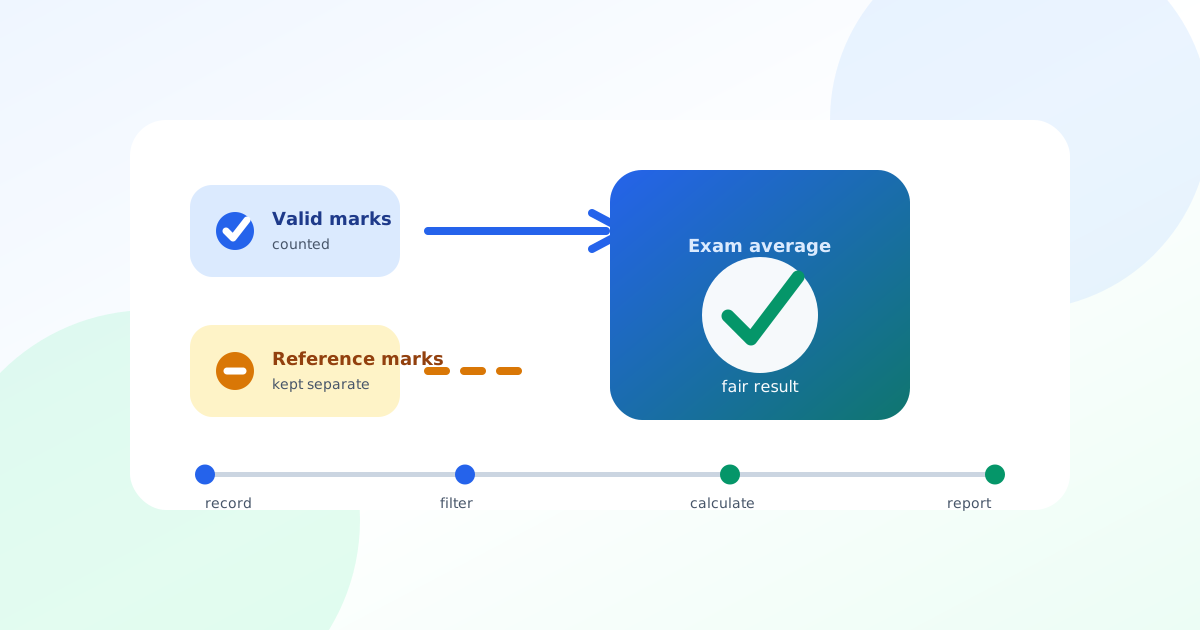
Fair exam averages improve school reports by counting only the marks that should be counted. This prevents wrong totals, misleading averages, and parent confusion when some assessments are absent, excluded, or not applicable.
- 1. Report cards become easier to trust.
- 2. Teachers avoid manual average corrections.
- 3. Parents see marks that reflect the right assessment rules.
Academic coordinators
Set cleaner rules for marks and averages.
Teachers
Spend less time fixing report-card calculations.
Parents
Receive clearer academic updates.
Exam season is not only about taking tests. It is also about trust.
A principal, exam head, or class teacher may spend many days checking marks. Parents then see one final number on a report card. That number must feel fair. It must also be easy to explain.
This is where small details matter.
In many schools, not every recorded mark should be counted in the final exam average. Some entries are practice work. Some are trial observations. Some may be kept only for teacher reference. Some may be marked as not for exam calculation.
If these entries are still counted by mistake, the average can become wrong. A child’s result may look lower or higher than it should. Teachers then need to recheck sheets. Parents ask questions. Admin teams lose time.
Unity helps schools avoid this kind of result stress by keeping exam calculation clear and controlled.
Why the average must use the right inputs
A simple average sounds easy. Add the marks. Divide by the number of entries.
But school data is rarely that simple.
A student may have five valid exam marks and two extra entries that should not affect the result. If the system divides by all seven entries, the average changes. If it divides only by the five valid entries, the result is fair.
This difference may look small on paper. In real school work, it matters a lot.
It can affect report cards, parent meetings, teacher review, remedial planning, and academic dashboards. It can also create extra correction work near the deadline, when the exam team is already busy.
A good ERP should not make staff remember every rule in a spreadsheet. The rule should be part of the exam workflow.
When every entry is counted
- Practice marks can distort final averages.
- Teacher-reference entries may affect report cards.
- Exam teams need manual rechecking.
- Parents may question corrected results later.
When only valid entries count
- Non-counting marks stay in history.
- The average uses only eligible records.
- Report-card numbers are easier to explain.
- Staff spend less time fixing sheets.
Clear rules reduce manual result checking
Many schools still depend on Excel files during result season.
- One teacher tracks class tests.
- Another tracks activities.
- The exam cell combines marks.
- Coordinators check missing entries.
- Someone confirms which marks should count.
This process is tiring. It is also easy to get wrong.
Unity is built to reduce this manual load. When marks, observations, and assessment rules stay inside one system, the school can process results with more confidence.
If an entry is not meant for exam calculation, it should stay out of the average. The system should not silently count it in the denominator. This keeps the result closer to the school’s real assessment plan.
It also helps teachers focus on learning support instead of repeated calculation checks.
Better results mean better parent conversations
Parents do not want a complex explanation of backend rules. They want to know whether the mark shown is correct.
When report-card numbers are clean, parent conversations become easier. Teachers can explain student progress with confidence. Principals can trust the reports shared by the exam team. Administrators can avoid last-minute correction cycles.
This is very important for Indian schools that handle unit tests, periodic tests, term exams, projects, activities, and co-scholastic grades across many sections.
One wrong average can become many support calls. One clear rule can prevent that.
Clean calculations also support composite assessment workflows, where different assessment types may carry different rules.
One marks record, many outcomes
A fair average helps every team trust the same result.
Teachers
Spend less time checking whether extra entries changed the final number.
Exam heads
Process results with rules that match the school’s assessment plan.
Parents
See clearer marks and fewer corrected report-card numbers later.
Useful for CBSE, ICSE, State board, and college workflows
Every institution has its own assessment style.
A CBSE school may track periodic tests, notebooks, subject enrichment, and term exams. A State board school may need a simpler marksheet, but still needs clean data. A college may use internal assessment, practical work, attendance-linked marks, and final exams.
The common need is the same: count the right items, skip the wrong ones, and show a clear result.
Unity supports this practical reality. It is not just about storing marks. It is about making result work easier for the people who run the institution.
What leaders gain from clean exam averages
Clean averages are not only an exam-cell benefit. They help the whole institution.
- Teachers spend less time checking calculation mistakes.
- Exam heads can process results faster.
- Principals get more reliable academic reports.
- Parents receive clearer marks and fewer corrections.
- Students get a fairer view of their performance.
This also helps leadership teams compare results across classes, sections, and academic years with more confidence.
When data is clean at the source, academic analytics becomes more useful. Leaders can see learning gaps, review subject performance, and plan support without doubting the basic marks.
Common questions about exam averages
What makes an exam average unfair?
An exam average becomes unfair when records that should not count are still included in the total or denominator.
Why should non-exam entries stay in the system at all?
Schools may still need them for teacher review, practice tracking, observations, or internal history. They should remain visible without affecting final exam results.
Who benefits most from this?
Exam heads, class teachers, coordinators, principals, parents, and students all benefit because the final number is easier to trust and explain.
Small workflow improvements create big trust
Parents may not see the work behind a report card. But they feel the result.
If marks are corrected again and again, trust reduces. If report cards are late, pressure increases. If teachers cannot explain a number clearly, the school looks less prepared.
A clean exam average rule is a small improvement. But it supports a bigger goal: fair results, faster processing, and better communication.
That is the kind of practical improvement Unity is built for.
It helps schools and colleges move away from manual stress and toward simple, reliable academic operations.
Next step
Ready to make result season simpler and more trusted?
See how Unity can help your institution save time on exam work and give parents clearer academic updates.